

Cora di Brazzà Foundation Announces London International Women’s Day Collaboration Honoring Nurse Catherine Pine
Logo of the Cora di Brazzà Foundation
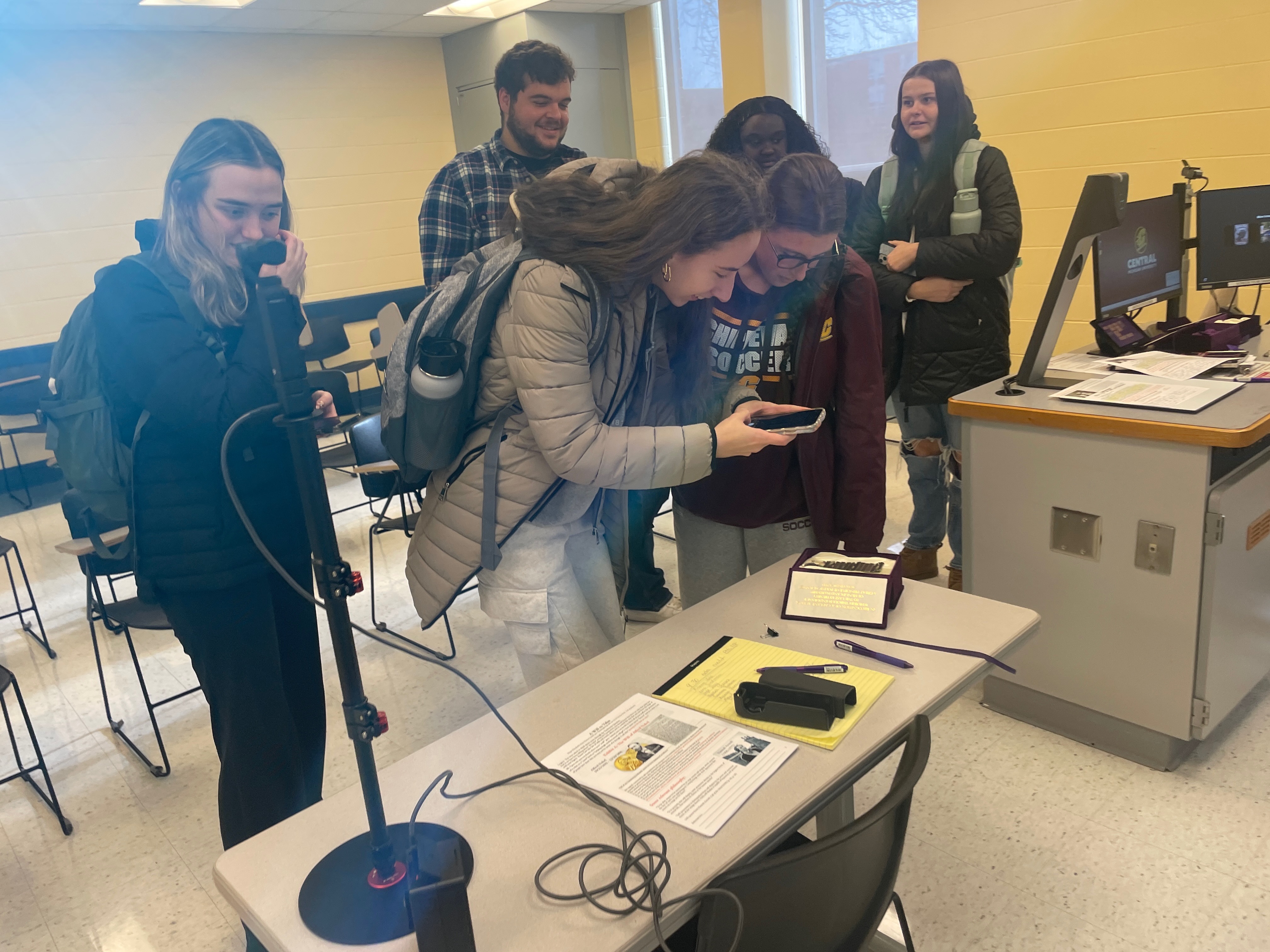
Dr. Hope Elizabeth May's students at Central Michigan University in a special session discussing historical, philosophical, and legal dimensions of Nurse Catherine Pine's legacy and suffragette medal (November 2024)

Nurse Catherine Pine "In Focus" at the Florence Nightingale Museum, London (March 6 to October 4, 2026)
In partnership with the Florence Nightingale Museum and The Philosophy Foundation—connecting fragmented narratives of care, conscience, and moral agency
Nurse Pine served as personal nurse to Emmeline Pankhurst (1858–1928), who founded the Women’s Social and Political Union (WSPU) in 1903, and became a central figure of the British women’s suffrage movement. The British suffragette campaign required trained nursing care because many imprisoned women undertook hunger strikes and were subjected to forcible feeding—practices that created serious medical risks and profound ethical concerns. Under Pankhurst’s leadership, the WSPU helped shape a new generation of activists, including American suffragists Alice Paul (1885–1977) and Lucy Burns (1879–1966). After returning to the United States, Paul and Burns founded the National Woman’s Party (NWP). Adapting British suffragette methods to the American context, the NWP introduced disciplined civil disobedience, mass pageantry, and, in some cases, imprisonment, hunger strikes, and forcible feeding.
Pine’s close proximity to Pankhurst placed her at the heart of this transatlantic suffrage moment—not only as caregiver, but as witness to the physical and ethical costs of political exclusion. In recognition of her service, she was awarded a suffragette medal inscribed “For Duty.” Unlike the better-known hunger-strike medals, Pine’s medal emphasized professional obligation, care, and moral resolve. Today, suffragette medals are highly sought-after historical objects, frequently acquired by museums and public archives throughout the United Kingdom and Commonwealth. For instance, the hunger-strike medal awarded to Maud Joachim sold at Bonhams in London on 3 October 2023 for £41,600 (approximately $51,000 USD), when it was purchased by Glasgow Women's Library in Scotland, demonstrating strong collector and institutional demand. Nurse Pine’s medal, however, entered a private collection in the United States, placing it at risk of permanent removal from the public educational use she intended.
Aware of Pine’s bequest, Dr. Hope Elizabeth May, professor of philosophy at Central Michigan University and founder of the Cora di Brazzà Foundation, worked closely with British suffrage historian Elizabeth Crawford, O.B.E., in an effort to prevent the medal’s sale, or at least to secure its acquisition by a UK archive. When those efforts proved unsuccessful, Dr. May acquired the medal at auction in 2024 in order to steward it in accordance with Pine’s stated wishes. Incorporated into Dr. May’s interdisciplinary teaching at Central Michigan University, the medal has since served as a focal point for reflection on women’s history, moral agency, and the ethics of memory. It is now being “called home” to London, where it will go on public display for the first time at the Florence Nightingale Museum.
Beginning Friday, March 6, 2026, the Florence Nightingale Museum will present In Focus: Nurse Catherine Pine, running through Sunday, October 4, 2026. The exhibition marks the return of Pine’s “For Duty” medal to London and situates her story within the broader histories of nursing, suffrage, and women’s civic courage. Dr. May, along with Central Michigan University alumni active in the Cora di Brazzà Foundation, will attend the exhibition’s opening.
“We are delighted to be working with Dr. May and to be telling Catherine Pine’s story,” said Hannah Amos, Perseverance Curator at the Florence Nightingale Museum. “We strive to tell the little-known stories of nurses who have helped contribute to the field and continued Nightingale’s legacy. The chance to display the medal is a fantastic opportunity for the museum and for our In Focus series of exhibitions. We are honored to be able to fulfill Pine’s wishes for the medal and hope that it inspires and educates our visitors.”
This collaboration, launched in connection with International Women’s Day, carries particular resonance as the United States enters the semiquincentennial year of the Declaration of Independence. Although the legal traditions of the United States and the United Kingdom are distinct, American law inherited much from the British system—including the common law, a Bill of Rights tradition, and doctrines such as coverture that shaped women’s exclusion from full civic and legal standing on both sides of the Atlantic. In both British and American jurisprudence, this exclusion was reinforced by principles traceable to English jurist and Oxford professor, William Blackstone (1723-1780), whose influential articulation of coverture treated married women as legally subsumed under their husbands. Early U.S. suffragists such as Lucretia Mott, Susan B. Anthony, and Elizabeth Cady Stanton, explicitly criticized Blackstone’s framework, urging that the founding philosophy of the United States was inconsistent with the inherited and outdated British legal framework. In 1888, American and British Women formed the International Council of Women to create a transatlantic network of reformers committed to the vision expressed in the Declaration of Independence that equality for all is a “self-evident truth.”
Working in partnership with The Philosophy Foundation, which exposes young people to philosophical inquiry, Dr. May, the Cora di Brazzà Foundation, and the Florence Nightingale Museum, are also developing age-appropriate educational programming that explores posthumous harm, last wishes, moral agency, and the ethical dimensions of property. The initiative seeks to help young people understand both the deep historical connections between British and American suffrage movements and the enduring philosophical questions they raise.
“The Philosophy Foundation is thrilled to be working in partnership with Dr. May and The Florence Nightingale Museum to develop and facilitate workshops exploring some of the wider themes of the Nurse Pine exhibition,” said Kim Down, a member of the executive team at The Philosophy Foundation. “Using the Pine medal as a stimulus, our philosophical workshops will give young people the chance to think deeply and discuss ideas around posthumous ethics, suffrage, equality, and ownership.”
“This is not simply about returning an object to London,” said Dr. May. “It is about repairing an injury—whether intentional or not—to Catherine Pine’s legal right to direct her property to a charitable, educational use. That right was part of her moral personality and autonomy, and respecting it is a duty.”
Hope Elizabeth May
The Cora di Brazzà Foundation
email us here
Legal Disclaimer:
EIN Presswire provides this news content "as is" without warranty of any kind. We do not accept any responsibility or liability for the accuracy, content, images, videos, licenses, completeness, legality, or reliability of the information contained in this article. If you have any complaints or copyright issues related to this article, kindly contact the author above.
