

Renewable Natural Gas (RNG) Market to Reach USD 29.7 Billion by 2035 as Energy Systems Shift Toward Sustainability
Renewable Natural Gas (RNG) Market
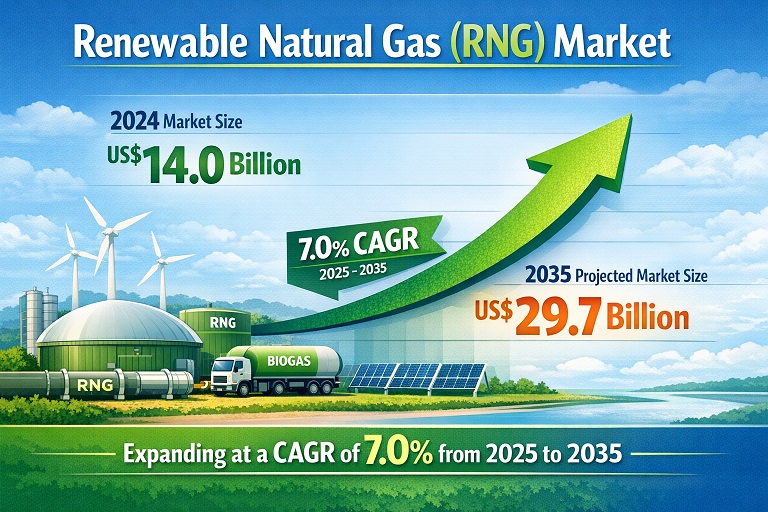
The renewable natural gas (RNG) industry is expected to grow at a CAGR of 7.0% from 2025 to 2035”
WILMINGTON, DE, UNITED STATES, February 20, 2026 /EINPresswire.com/ -- The Renewable Natural Gas (RNG) Market was valued at approximately USD 14.0 billion in 2024 and is projected to reach nearly USD 29.7 billion by 2035, expanding at a robust CAGR of 7.0% during the forecast period. Growth is being driven by rising global emphasis on decarbonization, increasing government incentives for low-carbon fuels, and expanding adoption of RNG across transportation, power generation, and industrial applications. Strong investments in anaerobic digestion infrastructure, landfill gas recovery projects, and biomethane upgrading technologies are further accelerating market expansion, positioning renewable natural gas as a key contributor to the global clean energy transition.— By Transparency Market Research
The global Renewable Natural Gas (RNG) Market is witnessing unprecedented momentum, driven by surging demand for clean fuels, supportive government policies, and the decarbonization goals of key industries. Renewable natural gas — also known as biomethane — is produced from organic waste streams and serves as a low-carbon alternative to conventional fossil-based natural gas. With sustainability at the forefront of energy strategies worldwide, the RNG market is poised for significant expansion in the coming decade.
Download Your Report Sample – Preview Market Opportunities: https://www.transparencymarketresearch.com/sample/sample.php?flag=S&rep_id=86872
Understanding Renewable Natural Gas (RNG)
Renewable Natural Gas (RNG) is a biofuel derived from organic waste sources such as agricultural residue, landfills, wastewater treatment facilities, and livestock manure. The organic matter decomposes to produce biogas, which is then upgraded to biomethane — a pipeline-grade gas with high methane content suitable for power generation, transportation fuel, and industrial use.
What differentiates RNG from conventional natural gas is its carbon profile. Since RNG is generated from waste that would otherwise release greenhouse gases (GHGs), its use can result in negative or near-zero carbon emissions, significantly helping countries and organizations to curb greenhouse gas output.
Key Players:
• Clean Energy Fuels
• BP Plc
• Ameresco
• Montauk Renewables
• Verbio SE
• Opal Fuels
• WM Intellectual Property Holdings, L.L.C.
• Fortis BC
• Vanguard Renewables
• Shell Biogas
• Other Leading Companies
Key Growth Drivers
1. Increasing Regulatory Mandates and Incentives
Globally, governments are embedding renewable natural gas into climate action frameworks. In North America and Europe, renewable fuel standards and carbon credit programs are driving industry participation. Incentives such as tax credits for RNG production and blending targets for renewable fuels are encouraging investments in biogas upgrading facilities.
Regulatory frameworks that accommodate carbon intensity scoring, such as California’s Low Carbon Fuel Standard (LCFS), have elevated RNG’s competitiveness as a low-carbon fuel for transportation and heating applications.
2. Corporate Net-Zero Commitments
Private and public corporations are increasingly transitioning toward cleaner energy portfolios. Major logistics, manufacturing, and energy firms are incorporating RNG usage into their Scope 1 and Scope 2 emission reduction strategies. Renewable natural gas offers an immediate pathway to reduce emissions from vehicle fleets and industrial processes.
3. Rising Demand for Sustainable Transport Fuels
The transportation sector has historically been a significant contributor to global emissions. RNG, when used as a vehicle fuel — particularly in heavy-duty trucks and buses — can reduce carbon emissions by up to 90% compared to conventional diesel, making it an attractive solution for green transportation initiatives.
4. Expansion of Biogas Capture Infrastructure
Enhanced technologies for biogas collection and upgrading are lowering barriers to RNG production. Municipalities and agricultural operations are increasingly deploying anaerobic digestion systems that capture methane from waste sources, yielding cost-effective raw biogas for RNG processing.
Market Challenges
Despite strong tailwinds, the RNG market faces several challenges:
High Initial Capital Investments: Building and upgrading biogas refining facilities require significant upfront cost, which can hinder entry for smaller players.
Feedstock Variability: Differences in organic waste composition can affect biogas yield and quality, complicating long-term planning.
Limited Pipeline Integration: In some regions, infrastructure constraints limit the connectivity of RNG output with existing natural gas distribution networks.
Industry stakeholders are actively addressing these challenges by forming strategic partnerships, sharing infrastructure investments, and adopting modular upgrading technologies to better manage production variability.
Get this premium report for strategic insights: https://www.transparencymarketresearch.com/checkout.php?rep_id=86872<ype=S
Market Segmentation
Feedstock Source
• Agriculture Waste
• Organic Municipal Solid Waste
• Industrial Organic Waste
• Wastewater Treatment Plant
• Landfill Gas
• Forestry Residues
• Energy Crops
• Animal Manure
• Others
Product Type
• Compressed Renewable Natural Gas
• Liquefied Renewable Natural Gas
• Pipeline-Grade Renewable Natural Gas
• Others
Technology
• Anaerobic Digestion
• Landfill Gas Recovery Systems
• Thermal Gasification
• Pyrolysis
• Fermentation
• Others
Application
• On-site Electricity Generation
• Residential Heating
• Commercial & Industrial Heating
• Transportation Fuel
• Industrial Process Fuel
• Gas Grid Injection
• Hydrogen Production
• Others
End-user
• Utilities
• Transportation
• Commercial
• Industrial
• Residential
Regional Market Insights
North America
North America currently represents the largest share of the global RNG market, bolstered by substantial policy incentives, thriving waste management infrastructure, and supportive clean fuel programs. The United States and Canada are leading investments in anaerobic digesters and RNG facilities, especially within agricultural and landfill settings.
Europe
In Europe, the drive toward carbon neutrality by 2050 under the European Green Deal has escalated demand for RNG. Countries such as Germany, France, and the Netherlands are implementing ambitious renewable energy targets and funding mechanisms to accelerate biomethane production.
Asia Pacific
The Asia Pacific region is emerging as a dynamic growth hub for RNG, particularly in China and India, where increasing energy demand, pollution concerns, and favorable renewable energy policies are creating fertile ground for RNG deployment. However, the market is still in early developmental stages compared to Western regions.
Latin America and Middle East & Africa
While still nascent in terms of RNG adoption, several countries in Latin America and the Middle East are exploring biogas utilization as part of waste-to-energy initiatives. Brazil and South Africa are among the regions evaluating policy frameworks to support future RNG growth.
Future Outlook
The renewable natural gas market outlook remains robust as governments, industries, and communities strive to meet sustainability goals. Advancements in biogas upgrading technology, scaling of production facilities, and broader integration with renewable energy systems will support ongoing expansion.
In addition, cross-sector collaboration between waste management, agriculture, transportation, and utility industries will enable more efficient biogas capture and greater RNG deployment. As demand for low-carbon alternatives accelerates, RNG is poised to play a pivotal role in the global energy transition.
Frequently Asked Questions (FAQs)
1. How big was the renewable natural gas (RNG) market in 2024?
The renewable natural gas (RNG) market was valued at US$ 14.0 Billion in 2024
2. How is the renewable natural gas (RNG) industry expected to grow by 2035?
The renewable natural gas (RNG) industry is expected to grow at a CAGR of 7.0% from 2025 to 2035
3. What are the key drivers of the renewable natural gas (RNG) market?
Strong policy incentives and decarbonization mandates and rising demand for low-carbon transportation and energy solutions
4. Which was the largest segment of the renewable natural gas (RNG) market in 2024?
Compressed renewable natural gas was the largest product type segment in the global renewable natural gas (RNG) market.
5. Which region was the most lucrative in the renewable natural gas (RNG) market in 2024?
North America was the most lucrative region in 2024
More Trending Reports by Transparency Market Research –
Mobile Energy Storage Systems Market - https://www.transparencymarketresearch.com/mobile-energy-storage-systems-market.html
Compressed Natural Gas Market - https://www.transparencymarketresearch.com/compressed-natural-gas.html
Waste-to-Energy Market - https://www.transparencymarketresearch.com/waste-to-energy-market.html
Abhishek Budholiya - Marketing Team
Transparency Market Research Inc.
+ +1 518-618-1030
email us here
Legal Disclaimer:
EIN Presswire provides this news content "as is" without warranty of any kind. We do not accept any responsibility or liability for the accuracy, content, images, videos, licenses, completeness, legality, or reliability of the information contained in this article. If you have any complaints or copyright issues related to this article, kindly contact the author above.
