

Your best source on government and non-profits news from the United States
Provided by AGP
E-Commerce Market Size is Expected to USD 243.40 Trillion By 2034 | CAGR: 24.54%
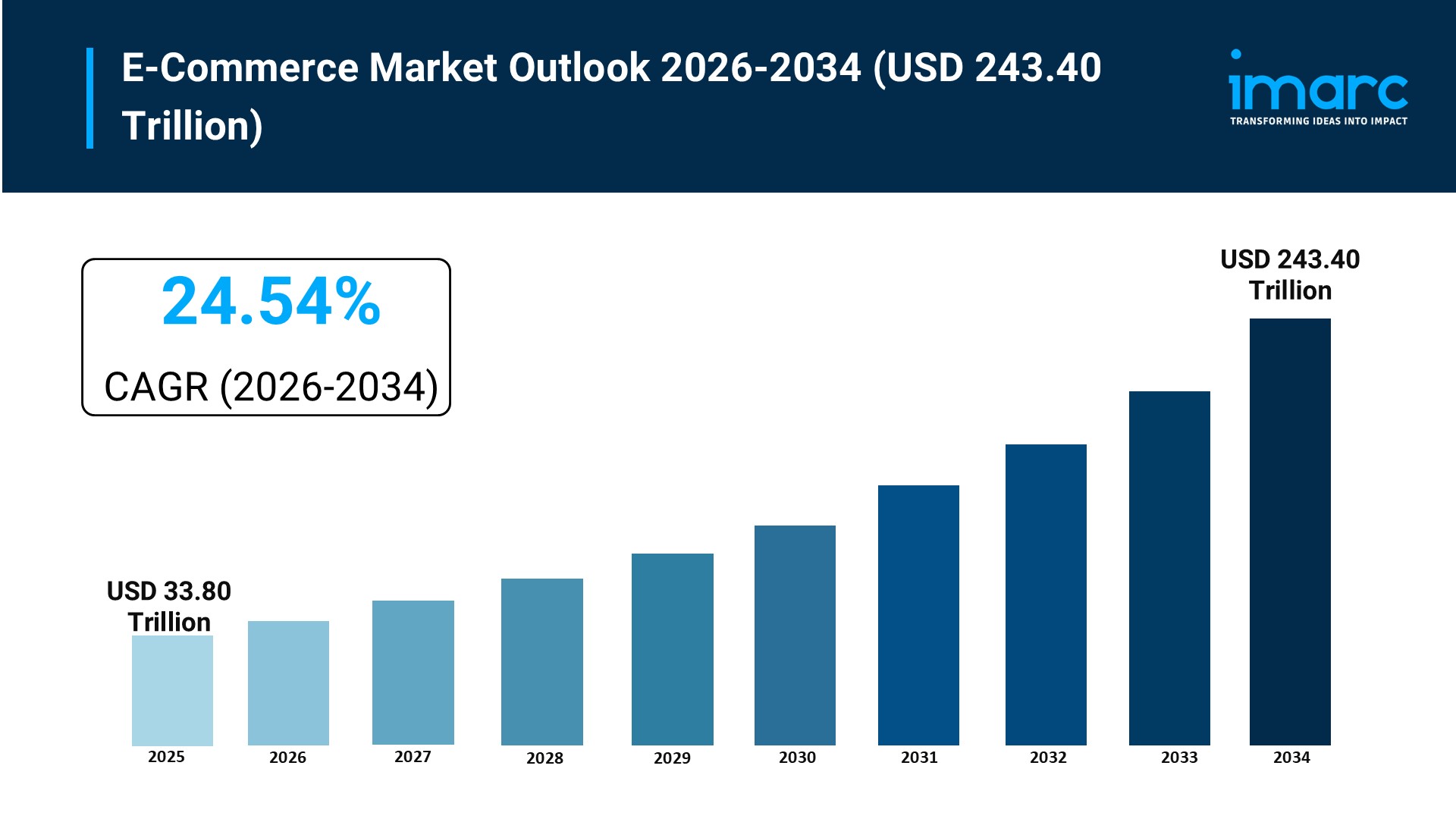
E-Commerce Market
The global e-commerce market size was valued at USD 33.80 Trillion in 2025.
SHERIDAN, WY, UNITED STATES, May 13, 2026 /EINPresswire.com/ -- The global e-commerce market size was valued at USD 33.80 Trillion in 2025 and is projected to reach USD 243.40 Trillion by 2034, exhibiting a CAGR of 24.54% during the forecast period 2026-2034, according to the latest market research report by IMARC Group. The sector is experiencing strong growth momentum, fueled by rising AI-driven capabilities, rapid smartphone proliferation, expanding cross-border trade corridors, and accelerating adoption of secure digital payment systems. Demand dynamics are signaling a robust growth trajectory as consumers globally shift toward digital-first purchasing behavior across product categories.𝐑𝐞𝐩𝐨𝐫𝐭 𝐇𝐢𝐠𝐡𝐥𝐢𝐠𝐡𝐭𝐬
● 𝐌𝐚𝐫𝐤𝐞𝐭 𝐒𝐢𝐳𝐞 (𝟐𝟎𝟐𝟓): 𝐔𝐒𝐃 𝟑𝟑.𝟖 𝐓𝐫𝐢𝐥𝐥𝐢𝐨𝐧
● 𝐌𝐚𝐫𝐤𝐞𝐭 𝐅𝐨𝐫𝐞𝐜𝐚𝐬𝐭 (𝟐𝟎𝟑𝟒): 𝐔𝐒𝐃 𝟐𝟒𝟑.𝟒𝟎 𝐓𝐫𝐢𝐥𝐥𝐢𝐨𝐧
● 𝐂𝐀𝐆𝐑 (𝟐𝟎𝟐𝟔-𝟐𝟎𝟑𝟒): 𝟐𝟒.𝟓𝟒%
● 𝐋𝐞𝐚𝐝𝐢𝐧𝐠 𝐑𝐞𝐠𝐢𝐨𝐧: 𝐀𝐬𝐢𝐚 𝐏𝐚𝐜𝐢𝐟𝐢𝐜
● 𝐓𝐨𝐩 𝐒𝐞𝐠𝐦𝐞𝐧𝐭 𝐛𝐲 𝐓𝐲𝐩𝐞: 𝐇𝐨𝐦𝐞 𝐀𝐩𝐩𝐥𝐢𝐚𝐧𝐜𝐞𝐬
● 𝐋𝐞𝐚𝐝𝐢𝐧𝐠 𝐓𝐫𝐚𝐧𝐬𝐚𝐜𝐭𝐢𝐨𝐧 𝐌𝐨𝐝𝐞: 𝐁𝐮𝐬𝐢𝐧𝐞𝐬𝐬-𝐭𝐨-𝐂𝐨𝐧𝐬𝐮𝐦𝐞𝐫 (𝐁𝟐𝐂)
● 𝐊𝐞𝐲 𝐆𝐫𝐨𝐰𝐭𝐡 𝐃𝐫𝐢𝐯𝐞𝐫: 𝐀𝐈-𝐏𝐨𝐰𝐞𝐫𝐞𝐝 𝐏𝐞𝐫𝐬𝐨𝐧𝐚𝐥𝐢𝐳𝐚𝐭𝐢𝐨𝐧 𝐚𝐧𝐝 𝐌𝐨𝐛𝐢𝐥𝐞 𝐂𝐨𝐦𝐦𝐞𝐫𝐜𝐞
● 𝐅𝐚𝐬𝐭𝐞𝐬𝐭-𝐆𝐫𝐨𝐰𝐢𝐧𝐠 𝐓𝐫𝐞𝐧𝐝: 𝐎𝐦𝐧𝐢𝐜𝐡𝐚𝐧𝐧𝐞𝐥 𝐈𝐧𝐭𝐞𝐠𝐫𝐚𝐭𝐢𝐨𝐧 𝐚𝐧𝐝 𝐒𝐨𝐜𝐢𝐚𝐥 𝐂𝐨𝐦𝐦𝐞𝐫𝐜𝐞
𝐃𝐨𝐰𝐧𝐥𝐨𝐚𝐝 𝐚 𝐅𝐫𝐞𝐞 𝐒𝐚𝐦𝐩𝐥𝐞 𝐂𝐨𝐩𝐲 𝐨𝐟 𝐭𝐡𝐞 𝐑𝐞𝐩𝐨𝐫𝐭: https://www.imarcgroup.com/e-commerce-market/requestsample
𝐄-𝐂𝐨𝐦𝐦𝐞𝐫𝐜𝐞 𝐌𝐚𝐫𝐤𝐞𝐭 𝐎𝐮𝐭𝐥𝐨𝐨𝐤 𝟐𝟎𝟐𝟔-𝟐𝟎𝟑𝟒
E-commerce refers to the buying and selling of goods and services through digital platforms, encompassing business-to-consumer (B2C), business-to-business (B2B), and consumer-to-consumer (C2C) transaction models. What began as a niche channel has evolved into the primary retail infrastructure for billions of consumers across both developed and emerging economies.
The global market is currently valued at USD 33.8 Trillion, with the industry undergoing rapid transformation and scale-up across all major geographies. Rising numbers of smartphones and high-speed internet connections continue to make online shopping more accessible. Furthermore, the preference for user-friendly mobile apps and websites, combined with the expansion of third-party logistics providers and same-day delivery capabilities, is offering a highly favorable market outlook.
𝐄-𝐂𝐨𝐦𝐦𝐞𝐫𝐜𝐞 𝐌𝐚𝐫𝐤𝐞𝐭 𝐃𝐫𝐢𝐯𝐞𝐫𝐬 𝟐𝟎𝟐𝟔
𝟏. 𝐒𝐦𝐚𝐫𝐭𝐩𝐡𝐨𝐧𝐞 𝐏𝐫𝐨𝐥𝐢𝐟𝐞𝐫𝐚𝐭𝐢𝐨𝐧 𝐚𝐧𝐝 𝐈𝐧𝐭𝐞𝐫𝐧𝐞𝐭 𝐏𝐞𝐧𝐞𝐭𝐫𝐚𝐭𝐢𝐨𝐧
The single most powerful engine behind the e-commerce market is the global spread of internet-connected smartphones. The global smartphones market reached 1,468.4 Million Units in the most recently tracked period, making mobile devices the primary point of entry into digital commerce for the majority of the world's online shoppers. As mobile penetration deepens in emerging markets across South and Southeast Asia, Africa, and Latin America, the total addressable population for e-commerce platforms continues to expand at scale.
Governments are actively accelerating this trend. India's BharatNet program has extended broadband connectivity to rural areas, bringing millions of first-time internet users into the digital economy. Similarly, the European Commission's Digital Compass 2030 target calls for gigabit connectivity across all households, with the goal of putting more consumers online and within reach of cross-border e-commerce platforms.
𝟐. 𝐀𝐈-𝐏𝐨𝐰𝐞𝐫𝐞𝐝 𝐏𝐞𝐫𝐬𝐨𝐧𝐚𝐥𝐢𝐳𝐚𝐭𝐢𝐨𝐧 𝐚𝐧𝐝 𝐕𝐢𝐫𝐭𝐮𝐚𝐥 𝐂𝐨𝐦𝐦𝐞𝐫𝐜𝐞 𝐓𝐨𝐨𝐥𝐬
Artificial intelligence has become central to how e-commerce platforms attract, convert, and retain customers. Machine learning algorithms now power product recommendations, dynamic pricing models, inventory forecasting, and customer service automation across platforms of all sizes.
One standout application is the growing use of virtual fitting rooms. In recent years, Zalando, one of Europe's leading online fashion platforms, introduced its virtual fitting room for millions of customers, allowing users to create a 3D avatar by entering their height, weight, and gender to see how different sizes from various brands would fit them. This innovation directly tackles the industry's most expensive operational challenge: product returns. By improving fit accuracy before purchase, such AI tools lower return rates and reduce fulfillment costs, improving margin performance across the platform.
𝟑. 𝐂𝐫𝐨𝐬𝐬-𝐁𝐨𝐫𝐝𝐞𝐫 𝐓𝐫𝐚𝐝𝐞 𝐚𝐧𝐝 𝐋𝐨𝐠𝐢𝐬𝐭𝐢𝐜𝐬 𝐄𝐱𝐩𝐚𝐧𝐬𝐢𝐨𝐧
Globalization of supply chains has made it substantially easier for businesses to source products from different parts of the world and offer consumers a broader range of options at competitive prices. The emergence of third-party logistics providers is significantly shortening shipping and delivery timelines for cross-border orders, reducing one of the traditional barriers to international e-commerce participation.
The EU's e-Commerce Communication released in February 2025 specifically outlined coordinated tools to manage the surge in low-value imports into the European market, seeking to ensure consumer safety while maintaining fair competition. The Digital Services Act (DSA) and Digital Markets Act (DMA), both of which became fully effective through 2024-2025, now require all major online platforms to disclose algorithmic recommendation logic, prohibit dark pattern interfaces, and enforce "know your business customer" obligations across marketplaces operating within the EU. These regulations are reshaping how platforms like Amazon and Alibaba operate within one of the world's most important e-commerce regions.
𝐒𝐩𝐞𝐚𝐤 𝐃𝐢𝐫𝐞𝐜𝐭𝐥𝐲 𝐰𝐢𝐭𝐡 𝐚𝐧 𝐀𝐧𝐚𝐥𝐲𝐬𝐭 𝐟𝐨𝐫 𝐂𝐮𝐬𝐭𝐨𝐦𝐢𝐳𝐞𝐝 𝐈𝐧𝐬𝐢𝐠𝐡𝐭𝐬: https://www.imarcgroup.com/request?type=report&id=2243&flag=C
𝐄-𝐂𝐨𝐦𝐦𝐞𝐫𝐜𝐞 𝐌𝐚𝐫𝐤𝐞𝐭 𝐓𝐫𝐞𝐧𝐝𝐬 𝟐𝟎𝟐𝟔
𝐎𝐦𝐧𝐢𝐜𝐡𝐚𝐧𝐧𝐞𝐥 𝐈𝐧𝐭𝐞𝐠𝐫𝐚𝐭𝐢𝐨𝐧 𝐄𝐧𝐡𝐚𝐧𝐜𝐢𝐧𝐠 𝐂𝐮𝐬𝐭𝐨𝐦𝐞𝐫 𝐄𝐱𝐩𝐞𝐫𝐢𝐞𝐧𝐜𝐞
Companies are blending their physical and digital operations to offer smoother, more connected shopping experiences. Customers can now move seamlessly between in-store browsing, mobile app purchasing, curbside pickup, and home delivery within a single brand interaction. Retailers adopting omnichannel strategies are better positioned to meet evolving consumer habits, offering flexibility without compromising service quality.
This integration is proving particularly powerful for the home appliances and groceries segments, where consumers often begin their research online but may prefer to complete certain purchases in-store, or vice versa. The alignment of these touchpoints is helping fuel further growth in both B2C and B2B transaction volumes.
𝐑𝐢𝐬𝐞 𝐨𝐟 𝐒𝐨𝐜𝐢𝐚𝐥 𝐂𝐨𝐦𝐦𝐞𝐫𝐜𝐞 𝐚𝐧𝐝 𝐒𝐡𝐨𝐩𝐩𝐚𝐛𝐥𝐞 𝐂𝐨𝐧𝐭𝐞𝐧𝐭
Social commerce, driven by shoppable content on platforms such as Instagram and TikTok Shop, is blending social engagement with frictionless purchasing. This trend is accelerating mobile-driven e-commerce by eliminating the steps between product discovery and transaction completion. Brands investing in live shopping events, influencer partnerships, and in-feed checkout capabilities are capturing consumer attention at the precise moment of purchase intent.
In May 2025, TikTok Shop expanded its seller ecosystem significantly across Southeast Asian markets, while Meta continued to develop its shoppable Reels infrastructure across Facebook and Instagram, reinforcing the convergence of social media and digital retail.
𝐄𝐜𝐨-𝐅𝐫𝐢𝐞𝐧𝐝𝐥𝐲 𝐏𝐚𝐜𝐤𝐚𝐠𝐢𝐧𝐠 𝐚𝐧𝐝 𝐄𝐭𝐡𝐢𝐜𝐚𝐥 𝐒𝐨𝐮𝐫𝐜𝐢𝐧𝐠
The shift toward eco-friendly packaging and ethical sourcing is reshaping the operational priorities of e-commerce businesses. Consumer awareness around environmental impact is now directly influencing purchasing decisions. The EU's Digital Product Passport initiative, advancing under the Ecodesign for Sustainable Products Regulation, will require manufacturers and retailers to provide consumers with detailed information on product composition, raw material sourcing, carbon footprint, and disposal guidelines. Although full enforcement is scheduled for 2026, major e-commerce players are already aligning their product listings and supply chain disclosures with these requirements.
𝐁𝐲 𝐓𝐲𝐩𝐞 (𝐏𝐫𝐨𝐝𝐮𝐜𝐭 𝐂𝐚𝐭𝐞𝐠𝐨𝐫𝐲)
● Home Appliances: Leading segment, supported by consumer reliance on smart home technology and the convenience of comparing and purchasing appliances through mobile-optimized platforms without visiting physical stores.
● Apparel, Footwear and Accessories: High-volume segment driven by AI personalization, virtual fitting tools, and rapid returns logistics.
Cosmetics Growing segment fueled by influencer-driven social commerce and online-exclusive brand launches.
● Groceries: Expanding segment powered by quick commerce services and same-day delivery infrastructure.
● Books: Stable segment, predominantly digital with strong e-book and audiobook adoption.
● Others: Includes electronics, sports equipment, and emerging niche categories.
Leading Segment: Home Appliances dominate, as modern households increasingly depend on multiple smart appliances and consumers prefer to research and purchase them through accessible digital platforms.
𝐁𝐲 𝐓𝐫𝐚𝐧𝐬𝐚𝐜𝐭𝐢𝐨𝐧 𝐓𝐲𝐩𝐞
● Business-to-Consumer (B2C): The largest transaction segment, driven by direct-to-consumer platforms, fast fulfillment, and personalized digital experiences.
● Business-to-Business (B2B): Rapidly growing, with enterprise procurement increasingly shifting to digital platforms for sourcing, ordering, and supply chain management.
● Consumer-to-Consumer (C2C): Sustained by peer-to-peer resale platforms, second-hand marketplaces, and the circular economy trend.
● Others -- Includes government procurement and hybrid transaction models.
𝐑𝐞𝐠𝐢𝐨𝐧𝐚𝐥 𝐈𝐧𝐬𝐢𝐠𝐡𝐭𝐬: 𝐄-𝐂𝐨𝐦𝐦𝐞𝐫𝐜𝐞 𝐌𝐚𝐫𝐤𝐞𝐭
𝐀𝐬𝐢𝐚 𝐏𝐚𝐜𝐢𝐟𝐢𝐜 𝐌𝐚𝐫𝐤𝐞𝐭 𝐋𝐞𝐚𝐝𝐞𝐫
Asia Pacific holds the largest regional segment of the global e-commerce market, anchored by rapid urbanization, rising smartphone adoption, and the world's two largest e-commerce populations in China and India. Alibaba's platforms serve over 900 million consumers in China, while Flipkart and Amazon India compete aggressively for market share across India's rapidly expanding online retail base. Government initiatives such as India's Digital India program and China's New Infrastructure Plan continue to accelerate broadband deployment and digital payment adoption, reinforcing Asia Pacific's dominant regional position.
𝐍𝐨𝐫𝐭𝐡 𝐀𝐦𝐞𝐫𝐢𝐜𝐚
North America is a mature but high-value e-commerce region, characterized by strong logistics infrastructure, high consumer digital literacy, and consolidated market leadership. Amazon's platform dominance, combined with Walmart's accelerating omnichannel strategy and Shopify's empowerment of independent direct-to-consumer brands, keeps the region at the frontier of e-commerce innovation.
𝐄𝐮𝐫𝐨𝐩𝐞
Europe is a significant and increasingly regulated e-commerce region. The rollout of the DSA, DMA, European Accessibility Act, and the forthcoming Digital Product Passport framework is raising the compliance bar for all platforms operating in the region. The EU's February 2025 e-Commerce Communication specifically introduced coordinated actions to manage low-value import surges and protect European consumers and businesses from unfair competition.
𝐌𝐢𝐝𝐝𝐥𝐞 𝐄𝐚𝐬𝐭 𝐚𝐧𝐝 𝐀𝐟𝐫𝐢𝐜𝐚
The Middle East and Africa represent high-growth frontiers for e-commerce, supported by young, digitally connected populations, expanding logistics networks, and increasing government investment in digital infrastructure across the GCC and sub-Saharan Africa.
𝐕𝐢𝐞𝐰 𝐭𝐡𝐞 𝐅𝐮𝐥𝐥 𝐑𝐞𝐩𝐨𝐫𝐭: https://www.imarcgroup.com/e-commerce-market
𝐊𝐞𝐲 𝐂𝐨𝐦𝐩𝐚𝐧𝐢𝐞𝐬 𝐢𝐧 𝐭𝐡𝐞 𝐄-𝐂𝐨𝐦𝐦𝐞𝐫𝐜𝐞 𝐌𝐚𝐫𝐤𝐞𝐭
Major players profiled in the IMARC Group report include:
● Alibaba.com
● Amazon.com Inc.
● ASOS
● Best Buy
● eBay Inc.
● Flipkart Inc.
● Groupon Inc.
● JD.com Inc.
● Shopify Inc.
● Walmart Inc.
● Zalando SE
𝐎𝐭𝐡𝐞𝐫 𝐓𝐫𝐞𝐧𝐝𝐢𝐧𝐠 𝐑𝐞𝐩𝐨𝐫𝐭𝐬 𝐁𝐲 𝐈𝐌𝐀𝐑𝐂 𝐆𝐫𝐨𝐮𝐩:
3d Technology Market Research Report
6g Market Research Report
Auto Dimming Mirror Market Research Report
𝐄-𝐩𝐚𝐬𝐬𝐩𝐨𝐫𝐭 𝐌𝐚𝐫𝐤𝐞𝐭: https://www.imarcgroup.com/e-passport-market
𝐒𝐞𝐫𝐯𝐞𝐫 𝐂𝐡𝐚𝐬𝐬𝐢𝐬 𝐌𝐚𝐫𝐤𝐞𝐭: https://www.imarcgroup.com/server-chassis-market
𝐊𝐞𝐲 𝐓𝐚𝐤𝐞𝐚𝐰𝐚𝐲𝐬 𝐟𝐫𝐨𝐦 𝐭𝐡𝐞 𝐑𝐞𝐩𝐨𝐫𝐭
● Market projected to grow from USD 33.80 Trillion (2025) to USD 243.40 Trillion by 2034 at a 24.54% CAGR.
● Home Appliances lead the product type segmentation, driven by smart home adoption and digital-first purchasing behavior.
● Asia Pacific holds the largest regional share, anchored by China, India, and Southeast Asia's mobile-first consumer base.
● B2C transactions dominate the market, while B2B digital commerce is the fastest-expanding transaction model.
● AI-powered personalization, virtual commerce tools, and omnichannel integration are the defining competitive differentiators.
● Government frameworks including the EU's DSA, DMA, India's Digital India, and the OECD's updated 2025 e-commerce definition are reshaping the regulatory and operational landscape.
𝐀𝐛𝐨𝐮𝐭 𝐈𝐌𝐀𝐑𝐂 𝐆𝐫𝐨𝐮𝐩
IMARC Group is a leading market research company that offers management strategy and market research worldwide. The company partners with clients across all sectors and regions to identify their highest-value opportunities, address their most critical challenges, and transform their businesses. IMARC's information products cover major market, scientific, economic, and technological developments for business leaders in pharmaceutical, industrial, and high-technology organizations.
𝐂𝐨𝐧𝐭𝐚𝐜𝐭 𝐔𝐬
IMARC Group
134 N 4th St., Brooklyn, NY 11249, USA
Email: sales@imarcgroup.com
Tel: +1-631-791-1145
Website: www.imarcgroup.com
Elena Anderson
IMARC Services Private Limited
+1 201-971-6302
email us here
Legal Disclaimer:
EIN Presswire provides this news content "as is" without warranty of any kind. We do not accept any responsibility or liability for the accuracy, content, images, videos, licenses, completeness, legality, or reliability of the information contained in this article. If you have any complaints or copyright issues related to this article, kindly contact the author above.
